Reading Between the Saves: What a Client's Reference Photos Are Actually Asking For
The phone arrives face-up, slightly smudged, and there are eleven images saved. Some are screenshots from Instagram, one is a photo of a magazine page taken at a wonky angle, two are renders that look like they cost more than the house, and one, bless them, is a picture of a hotel bathroom in Lisbon. The client says: "Like this, but ours." And then they wait, hopefully, for you to say yes.
The temptation is to nod along and start talking about paint. Don't. What's in their hand isn't a brief — it's a mood with the reasoning stripped out. Your job over the next hour is to put the reasoning back in, then quietly swap out the bits that won't survive contact with a Victorian terrace in Sheffield.
First, sort the pile
Before you read anything into the images, work out what kind of images they are. That alone tells you a lot.
Screenshots usually mean aspiration. Someone saved a photo in a hurry, probably because a single element caught them — a colour, a bit of joinery, a lamp. They often can't tell you which bit, so ask.
Photographs taken in real rooms — a friend's kitchen, a café, a National Trust property — tend to signal something they've actually felt. Those are gold, because they come with a memory attached, and memories hold the details the client genuinely cares about.
Renders and CGI are the trickiest. They're lit from nowhere, the plants are perfect, and there is never a radiator, a bin, or a door that needs to open. Treat them as a signal of taste, not a specification.
Hotel and restaurant shots are about atmosphere rather than domestic reality. People save these when they want a feeling — usually calm, usually dim, usually a bit more expensive than their own hallway. That's a useful thing to know.
Light is always the first clue
Every image has a light source, and almost no client will mention it. Look at where the shadows fall and at what time of day the shot was taken. A room glowing at 4pm in November is a very different beast from a room glowing at 4pm in June.
South-facing rooms flatter almost anything, which is why so many saved images look effortless. A north-facing sitting room in Leeds will not accept the same scheme without a bit of negotiation — you'll need warmer tones, better lamps, and a willingness to paint the ceiling something other than brilliant white.
Ask the client what their room is like at 9am and at 6pm, in February and in July. If they don't know, that's your first homework task, and it's a far more useful one than choosing a paint colour.
The ceiling-height lie
This is the one that catches everyone. A generous, high-ceilinged shot with tall sash windows, a picture rail and a chandelier simply cannot be replicated in a 2.3-metre box room in a 1930s semi. It isn't a styling problem; it's a geometry problem.
So before you promise anything, check the vertical measurements. Then look at what the reference image is doing with that height — vertical panelling, long curtains, a tall mirror, a pendant hung low. Those moves are often portable even when the height isn't. A curtain hung at the ceiling line will buy you height in almost any British room, and a low pendant over a table works just as well under a modest ceiling as under a grand one.
Texture is what the screen can't tell you
A flat image can make rough lime plaster and wipe-clean vinyl look oddly similar. The client is responding to texture, even if they think they're responding to colour. So get specific: is that wall tadelakt or just a very good paint finish? Is the floor reclaimed oak, engineered oak, or a very convincing herringbone LVT?
Nine times out of ten, the client has saved the image for the texture and described it as the colour. Meet them where they actually are. If they want the patina of an old plaster wall, the answer might be limewash, not a £90 tin of matte emulsion.
Budget signals hide in plain sight
Look at the edges of the reference image. Bespoke joinery with shadow gaps, a marble upstand, a crittall-style screen, a full-height fluted island — these all cost money, and clients rarely realise which detail is doing the heavy lifting.
Your job is to find the cheap version of the expensive thing, and to be honest about which one they're looking at. A fluted island can be faked with a timber batten detail and a lot of patience. A crittall screen is rarely faked convincingly, so if that's the specific thing they love, say so early rather than halfway through a quote.
Now the British bit
Here's where translation really happens. British homes come with radiators in the worst possible spot, sash windows that whistle, a chimney breast that does something odd to the layout, and a damp patch that appears every January. A scheme copied straight from a styled render will fight all of that and lose.
So build the constraints into the design. Plan around the radiator rather than pretending it isn't there. Use the chimney breast as the anchor it wants to be. Allow for a boot tray and a wet-dog towel in the hallway. Choose fabrics that can take a bit of grey British daylight without going flat.
A room that suits a real British house — radiators, sashes, low winter light and all — will always look better in the long run than one that only works in a photograph.
Translate, don't transcribe
A simple method that saves a lot of back-and-forth: go through the saved images together and mark each one as keep, skip or swap.
- Keep — the thing they genuinely love and that will survive the constraints.
- Skip — the thing that only works because of the ceiling height, the budget or the Mediterranean light.
- Swap — the idea they love, translated into something that works in their actual room. Same feeling, different kit.
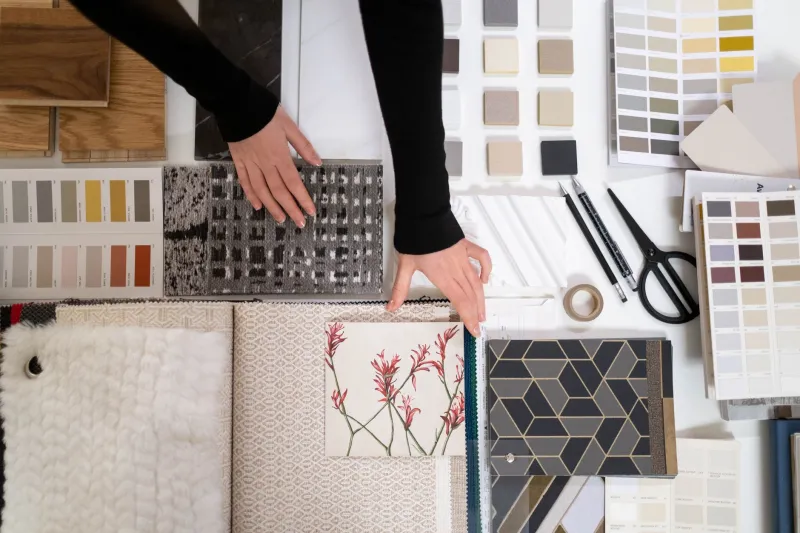
Then present it back as a scheme rather than a set of products. A mood board that says "this is what we heard, and this is what it becomes in your front room" lands far better than a spreadsheet of paint codes.
The screenshot in their hand isn't the brief. It's the opening line of one. Read it properly — the light, the height, the texture, the budget — and you'll end up with a room that feels like the photos, but actually fits the house.